Evaluating Tax Residency Tracking Software: A Feature-Based Buyer's Guide
The market for residency and travel day-count applications has expanded substantially. Taxpayers searching for tracking options now encounter everything from manual check-in tools and simple day counters to more sophisticated background-tracking platforms.
When significant personal income tax liabilities are at stake during a state, city, or international residency audit, selecting tracking software with the right underlying architecture is critical.
Some applications rely heavily on event-driven services such as geofence crossings or significant-location-change notifications. These mechanisms can be highly power efficient, but by themselves they do not provide periodic location observations while a device remains stationary. A user who stays at the same residence or hotel for several days may therefore have substantially fewer contemporaneous observations than a system that also performs scheduled background location checks.
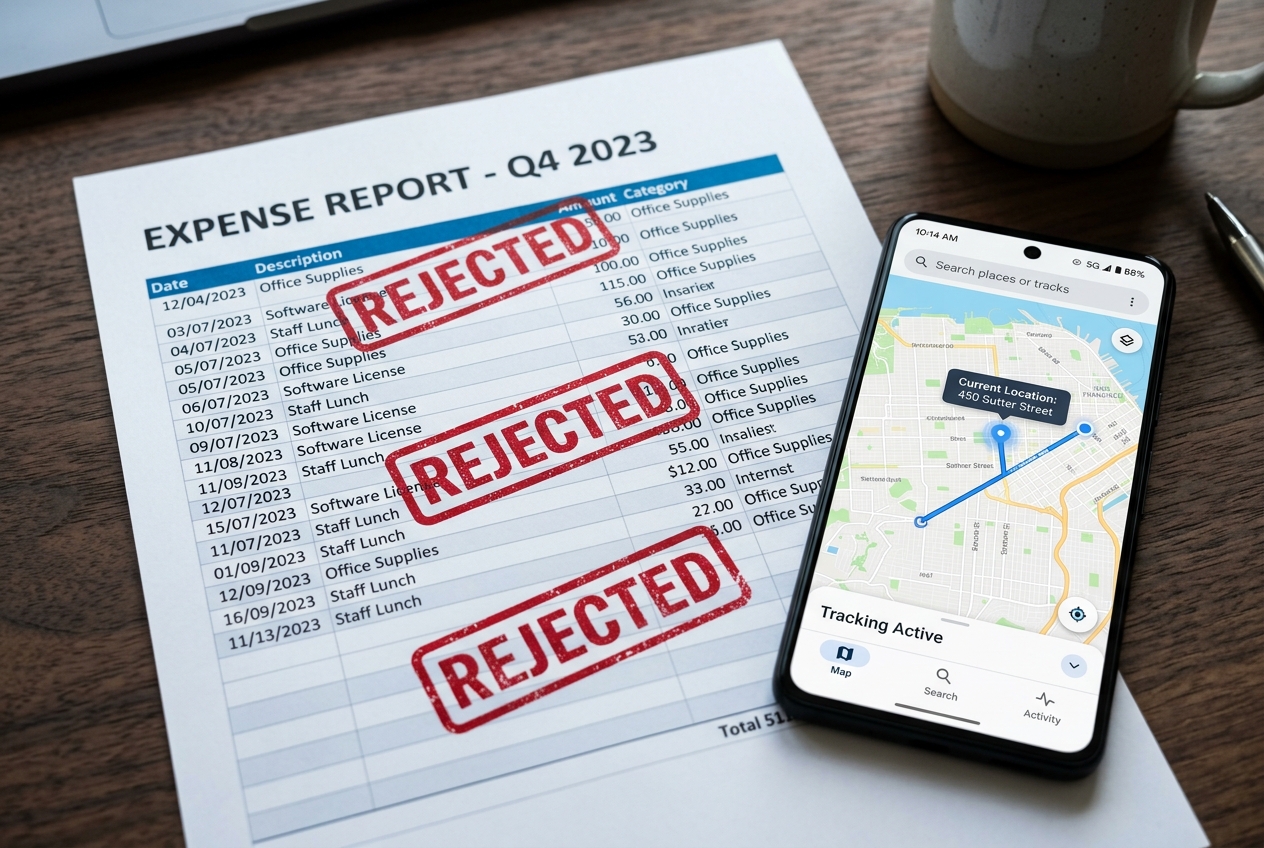
Why Tax Auditors Scrutinize Manual Spreadsheets
Manual Excel spreadsheets and basic calendar notes lack contemporaneous timestamps and cryptographic verification. A spreadsheet prepared after the fact may receive less evidentiary weight unless its entries can be corroborated by contemporaneous records.
Rather than publishing arbitrary rankings of fast-changing app listings, this guide provides the critical technical capabilities and feature requirements you should evaluate to help ensure your location evidence holds up under audit scrutiny.
How We Evaluated Residency Tracking Software
Our feature evaluation framework emphasizes key architectural requirements necessary for audit-level reliability: recurring background location observations, horizontal accuracy metadata, multi-jurisdictional depth, tamper-evident record integrity, encrypted cloud backup, and audit-ready reporting. Our evaluation framework focuses on technical specifications and location-logging standards rather than subjective user ratings.
Core Technical Features to Evaluate in a Residency App
For taxpayers who may need to substantiate physical presence during an audit, a tracking app should incorporate location technology designed to create a detailed, contemporaneous record throughout the day and during extended stationary periods. Look for these core technical features:
Automated Background Polling (~Every 15 Minutes or Regular Intervals)
Why It Matters: Unlike event-only tools that may drop stationary users, an audit-grade tracking engine is designed to collect recurring timestamped location observations at approximately 15-minute intervals, including during extended periods when the user remains stationary, subject to device, operating-system, permission, and connectivity conditions.
Fused Location Services & Accuracy Metadata
Why It Matters: A robust tracker should take advantage of the device's fused location services rather than assuming every location fix originates from standalone GPS. Modern mobile operating systems may derive location from GPS, Wi-Fi, cellular, and other available signals. The application should preserve the resulting coordinates, timestamps, and accuracy metadata so that the quality of individual observations can later be evaluated.
Multi-Jurisdiction Depth & City-Level Day Counting
Why It Matters: Some tracking tools monitor only state or country boundaries. However, municipal tax systems impose local income, wage, or residency taxes (such as New York City resident income tax, Yonkers resident tax surcharge, or Philadelphia city wage tax). Your software must track days down to the specific country, state, province, and city jurisdiction level.
App, Device & Location Integrity Safeguards
Why It Matters: Apple App Attest and Google Play Integrity can help establish that location submissions originate from a legitimate application running in an expected device environment. These services do not independently authenticate the truth of an individual GPS coordinate, so a robust anti-spoofing architecture should combine device/app attestation with available mock-location indicators, source metadata, server-side anomaly detection, and other integrity checks.
Cryptographically Signed, Tamper-Evident PDF Log Exports
Why It Matters: Editable CSV files, manually compiled records, and screenshots may be easier to alter than cryptographically verifiable reports. Look for software that generates cryptographically signed, timestamped PDF reports featuring precise coordinates, reverse-geocoded addresses, and jurisdiction day totals suitable for addressing evidentiary requirements in audits.
Data Storage Architecture: Encrypted Cloud Sync vs. Device-Only Storage Risks
Why It Matters: Some applications store location records exclusively on the user's local smartphone. Regardless of the reason, relying solely on device storage creates two potential vulnerabilities for taxpayers who may later need those records during an audit:
- Evidentiary & Provenance Risks: When location logs exist solely on a local device under the sole control of the user, tax auditors can raise questions regarding data provenance and authenticity.
- Irrecoverable Data Loss: Smartphones are regularly lost, stolen, damaged, replaced, or wiped during operating system updates. If years of day-count records exist solely on local phone storage without encrypted cloud backup, a lost or corrupted device can result in the loss of years of location records. Look for an application with encrypted cloud synchronization and server-side timestamps to improve data provenance and provide a recoverable backup if the device is lost, damaged, or replaced.
Horizontal Accuracy Radius Tracking & Border Inaccuracy Filtering
Why It Matters: Users must ensure that their selected app records and stores the horizontal accuracy radius (in feet, yards, or meters) for every location post. When traveling or residing near state, provincial, or international borders, if direct satellite GPS is unavailable (e.g., indoors or in urban canyons), mobile devices fall back to cellular or network location fixes. If you are close to a border, low-accuracy triangulation can erroneously place your location post across the border into an adjacent high-tax jurisdiction. By recording horizontal accuracy metadata for every location post, an audit-grade tracking app can screen out imprecise location entries near borders and prevent false-positive jurisdiction triggers.
Domicile365 Benchmark & Pending Patent Applications
3 U.S. Provisional Patent Applications FiledDomicile365 has filed three U.S. provisional patent applications covering aspects of its residency-tracking and audit-integrity technology. These patent-pending innovations specifically address key technical challenges in residency monitoring:
- Overnight & Stationary Location Verification: Proprietary algorithms designed to collect periodic location observations during extended stationary periods without excessive mobile battery drain.
- Device Attestation & Integrity Safeguards: Architecture incorporating Apple App Attest, Google Play Integrity, and mock-location detection to help verify genuine device and application environments.
- Cryptographically Signed Audit PDF Exports: Generating tamper-evident, verifiable PDF log exports designed to help corroborate location history for audit defense.

Jurisdictional Complexities: Evaluating Software Against Complex Tax Rules
Tax residency is governed by intricate statutory rules and legal case law across different jurisdictions. When evaluating tracking software, ensure it accounts for these specific jurisdictional nuances:
1. The UK Statutory Residence Test (SRT): The Midnight Rule, Tiered Day Bands & Deeming Rule
The UK Statutory Residence Test (SRT; HMRC Guidance RDR3 / Schedule 45, Finance Act 2013 ) is considerably more complex than a simple 183-day rule. A person's result can depend on automatic overseas tests, automatic UK tests, prior UK residence history, and the sufficient-ties test. Under the sufficient-ties test, the relevant day bands include 16–45, 46–90, 91–120, and more than 120 UK days, with the number of required UK ties varying according to prior residence history.
Under the SRT, presence is generally counted when an individual is present in the UK at the end of the day—commonly described as the midnight rule. In addition, under HMRC's deeming rule, certain taxpayers with at least three UK ties and more than 30 qualifying days can have additional days counted even when they were not present at the end of the day.
Furthermore, UK tax rules operate strictly on the UK Tax Year (April 6 to April 5) rather than standard calendar years. Residency tracking software must incorporate UK tax year boundaries and specialized presence rules.
2. California Residency: Facts-and-Circumstances Test (No Fixed 183-Day Rule)
California's official position (Cal. Rev. & Tax. Code § 17014 ) is that an individual is a resident if present in the state for other than a temporary or transitory purpose, or if domiciled in California while away only temporarily. California does NOT have a fixed 183-day statutory residency threshold.
While spending more than 9 months in California creates a statutory presumption of residency, because California residency is not determined by a 183-day bright line, an individual can be a California resident despite spending fewer than 183 days in the state if the overall facts demonstrate that the person's presence is not temporary or transitory. Detailed location records can help document the frequency, duration, and pattern of California presence. Those records can be valuable evidence, but physical presence is only one component of California's broader facts-and-circumstances residency analysis.
3. US Fixed 183-Day States & NY Partial-Day Rules
States like New York and Massachusetts enforce the fixed 183-day statutory residency test combined with maintaining a Permanent Place of Abode (PPOA). Under New York Tax Law § 605(b)(1)(B) (NYS Tax Law § 605 ) and 20 NYCRR § 105.20(c), presence for even a fraction of a day (unless solely in transit or for medical treatment) constitutes a full day in New York for statutory residency counting.
Meanwhile, landmark decisions in Matter of Gaied (22 N.Y.3d 269) and Matter of Obus (206 A.D.3d 1511) require a genuine showing of actual residential use, not merely legal access or physical suitability, for a dwelling to qualify as a Permanent Place of Abode. Tracking software must distinguish between daytime transit, working hours, and overnight physical presence across state lines.
4. Maryland's Unique 24-Hour Day-Counting Rule
Maryland imposes statutory residency on individuals maintaining a place of abode in Maryland who spend 183 days or more of the tax year in the state (Maryland Code, Tax-General § 10-101 ).
Maryland generally treats any part of a day as a day of physical presence. However, Maryland Administrative Release No. 37 provides an unusual limitation: a continuous period of 24 hours or less may not constitute more than one day. Thus, an overnight stay spanning two calendar dates can sometimes count as only one Maryland day if the continuous period of presence does not exceed 24 hours. Residency-tracking software designed for Maryland therefore needs elapsed-time tracking in addition to ordinary calendar-day counting.
5. Maritime & Waterway Tracking: Federal 12-NM vs. State Seaward Boundaries
Federal, state, and constitutional maritime boundaries are not always identical. For federal Substantial Presence Test (SPT) purposes under Treas. Reg. § 301.7701(b)-1(c)(2)(ii) , the definition of the United States includes U.S. territorial waters, which generally extend 12 nautical miles (NM) from applicable baselines.
State jurisdictional boundaries can differ depending upon the state and the legal purpose involved (such as the 3 nautical mile state seabed limit under the Submerged Lands Act or Florida's constitutional Atlantic boundary). Standard mobile operating system reverse-geocoders are built for land street navigation and often snap offshore fixes to nearby coastal addresses or fail altogether. Consequently, an offshore location should not simply be assigned to the nearest street address or assumed to follow a universal three-mile state boundary.
Dedicated tracking software should utilize specialized GIS boundary data for maritime fixes. For a deeper analysis of federal regulations and coastal geofencing, read the detailed guide on Counting Days on the Water: Maritime Geofencing & State Tax Boundaries .
Residency Tracking Software Benchmark Matrix
| Evaluation Criterion | What Buyers Should Verify | Domicile365 Approach |
|---|---|---|
| Location Logging Engine | Does it rely solely on movement/boundary events, or collect recurring observations? | Approx. 15-Min Background Observations + Fused Location |
| Stationary Tracking | Does it continue obtaining evidence during extended stationary periods (e.g. overnight)? | Scheduled Overnight & Stationary Verification |
| Device & App Integrity | Does it validate legitimate app/device environments and flag mock locations? | Apple App Attest & Google Play Integrity + Integrity Safeguards |
| Accuracy Metadata | Is horizontal accuracy radius retained with every observation to filter border errors? | Retained & Screened per Location Post |
| Data Storage & Backup | Are records securely backed up with server-side timestamps to protect against data loss? | Encrypted Cloud Sync & Server Timestamps |
| Audit Log Export | Are exported reports tamper-evident and cryptographically verifiable? | Cryptographically Signed PDF Log Exports |
| Jurisdiction Depth | Does it track across country, state, province, and city levels? | Country, State, Province, & City Level |
| UK SRT Compliance | Does it support April 6–April 5 tax year and midnight presence tracking? | UK Tax Year & Midnight Presence Tracking |
| Maryland Rule Compliance | Does it support continuous 24-hour location analysis? | Timestamped Location History Supporting 24-Hour Analysis |
| Maritime & Coastal Waters | Does it use geographic maritime boundary data rather than nearest-address geocoding? | Dedicated Maritime & Coastal GIS Processing |
Disclaimer: This guide is provided for general informational purposes and does not constitute tax or legal advice. Residency rules depend on individual facts and circumstances and are subject to change.
Automatically Document Where You Spend Your Days
Domicile365 combines recurring background location observations, jurisdiction-aware day counting, accuracy monitoring, secure cloud records, and audit-ready reporting. Start your 60-day free trial today.